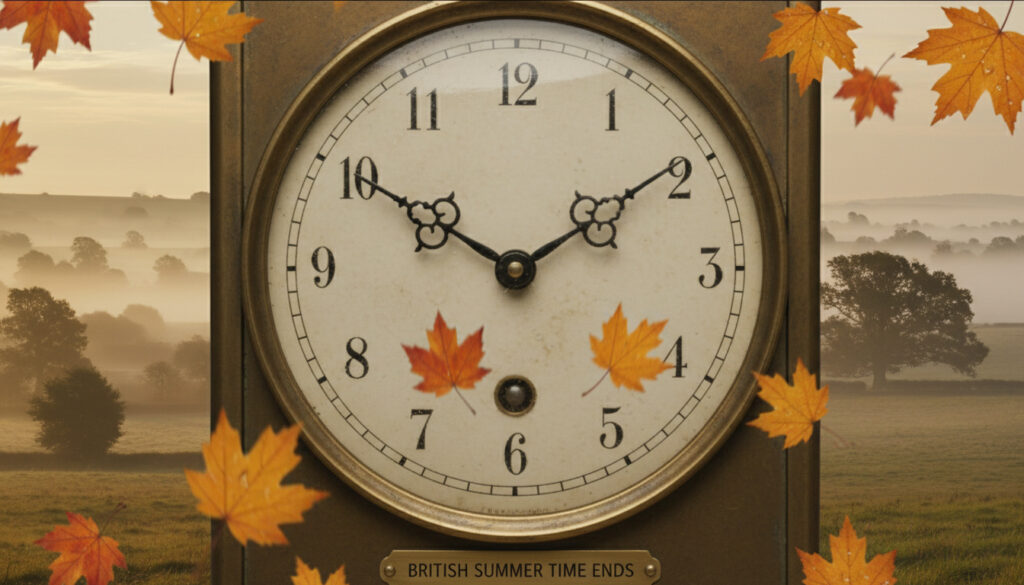
British Summer Time Ends 2025 – When and How to Change Clocks
Introduction
When British Summer Time concludes in 2025, millions of clocks across the United Kingdom will shift back one hour during the early hours of Sunday, 26 October. The transition marks the return to Greenwich Mean Time (GMT), providing an additional hour of daylight during morning hours while shortening evenings. This annual adjustment affects everything from transport schedules to digital devices, requiring preparation across households and industries alike.
Key Information
Date
26 October 2025
Time
02:00 becomes 01:00
Change
Clocks go back 60 minutes
Zone
BST to GMT
Context and Rationale
The practice of adjusting clocks seasonally has structured British timekeeping for over a century. Originally implemented to maximize daylight utilization during working hours, the system continues to influence energy consumption patterns and daily routines. While the European Union has debated abolishing these changes, the United Kingdom maintains the tradition, with UK time zones following the established biannual rhythm.
According to official government guidance, the clock change occurs at 01:00 GMT on the last Sunday of October, effectively moving time backward to 00:00. This shift creates a 25-hour day, offering the rare benefit of an extra hour’s sleep for those not working through the night.
2025 Time Change Schedule
| Location | Current Time (BST) | New Time (GMT) | Date |
|---|---|---|---|
| London | 02:00 | 01:00 | 26 Oct 2025 |
| Edinburgh | 02:00 | 01:00 | 26 Oct 2025 |
| Cardiff | 02:00 | 01:00 | 26 Oct 2025 |
| Belfast | 02:00 | 01:00 | 26 Oct 2025 |
Global timekeeping resources confirm that London transitions at 2:00 AM local time, synchronized across England, Scotland, Wales, and Northern Ireland.
Technical Implementation
Modern timekeeping relies on automated systems to execute the transition. Smartphones, computers, network servers, and connected devices typically adjust without manual intervention, synchronized to atomic clocks via internet protocols. However, mechanical clocks and appliances require manual correction. The Royal Museums Greenwich explains that standard time serves as the basis for civil timekeeping across the UK, with BST representing a temporary advance of one hour from March to October.
Transport networks operate contingency protocols during the changeover. Railway scheduling systems account for the duplicated 01:00 to 01:59 period, ensuring timetables remain coherent despite the temporal duplication. Aviation operates exclusively on Coordinated Universal Time (UTC), avoiding ambiguity regarding local offsets.
Critical Timeline
- 25 October 2025, 23:59: Final minute of BST
- 26 October 2025, 01:00: Clocks return to 00:00 GMT
- 26 October 2025, 02:00: Full hour repeated
- 30 March 2026: BST resumes
Common Points of Confusion
Many observers struggle to recall the direction of seasonal adjustments. The mnemonic “spring forward, fall back” assists memory, indicating advancement in March and retardation in October. This seasonal alternation determines whether to add or subtract an hour when setting non-digital timepieces.
Research published by sleep specialists indicates that autumn transitions generally cause fewer physiological disturbances than spring advances, though circadian rhythms still require adjustment. The NHS provides guidance on managing sleep patterns during temporal shifts, recommending gradual schedule modifications in the days preceding the change.
Societal Impact Assessment
The economic implications of reverting to GMT extend beyond individual schedules. Retail sectors report altered consumer behavior patterns as darkness falls earlier, affecting evening commerce. Energy consumption profiles shift, with lighting demands increasing during afternoon hours while morning requirements decrease. For those interested in the precise timing of these shifts, you can discover when British Summer Time ends in 2025 at What time is it in the UK.
Environmental considerations remain contentious. While proponents argue that extended evening daylight reduces artificial lighting needs, opponents note that darker mornings increase heating requirements and accident risks during commutes. The Parliamentary Office of Science and Technology has examined these trade-offs extensively, concluding that net energy savings remain marginal in modern contexts.
Expert Perspectives
“The transition back to Greenwich Mean Time represents more than a mechanical adjustment. It reconnects us with astronomical time, aligning civil hours with solar noon while acknowledging the seasonal variation in daylight availability.”
— Royal Observatory Greenwich
Technology analysts emphasize preparation for the 2025 change, noting that software systems handling the transition must account for the ambiguous hour between 01:00 and 02:00 occurring twice. Database timestamps require careful handling to distinguish between the first and second iteration of this period.
Summary
British Summer Time concludes on 26 October 2025 at 02:00, when clocks throughout the UK return to 01:00 GMT. This adjustment concludes the seven-month period of daylight saving, restoring standard time until late March 2026. While digital infrastructure manages the transition automatically, manual timepieces require attention to prevent scheduling errors. The change offers immediate benefits through additional rest while heralding the arrival of darker winter evenings.
Frequently Asked Questions
Do the clocks go back or forward in October 2025?
Clocks go back one hour on 26 October 2025 at 02:00, returning to 01:00 GMT.
Which Sunday in October do the clocks change?
The clocks change on the last Sunday of October, which falls on 26 October in 2025.
Do smartphones update automatically?
Devices connected to networks typically adjust automatically, though airplane mode or manual time settings may prevent synchronization.
Why does British Summer Time end?
The practice maximizes daylight during waking hours during summer while returning to solar-aligned time for winter months.
More related posts
 John Major – Complete Biography and Political Legacy
 Pom Pom Purin – The Complete Guide to Sanrio’s Beloved Dog
 Ralph Fiennes – Biography, Iconic Roles and Net Worth
 Breeda Wool – Age, Partner, and Full Career Guide
 Bryan Cranston – Biography, Net Worth, Family and Career
 Pubs Near Me Now – Find Open Pubs in Walking Distance
 Ariel Winter – Biography, Net Worth, and Modern Family Career
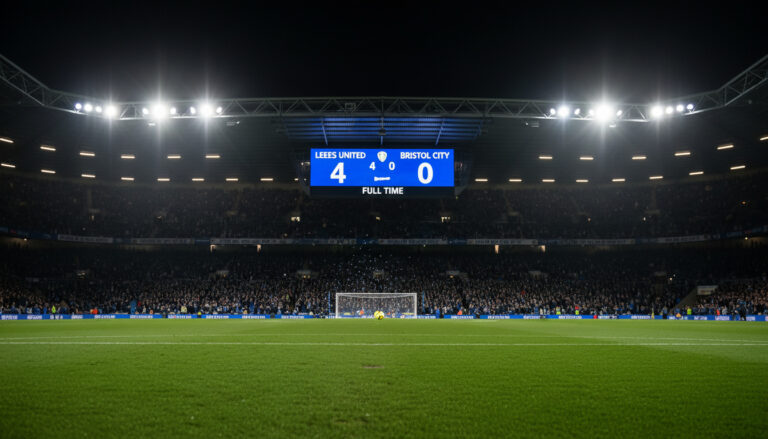 Leeds United vs Bristol City – 4-0 Result and Key Stats