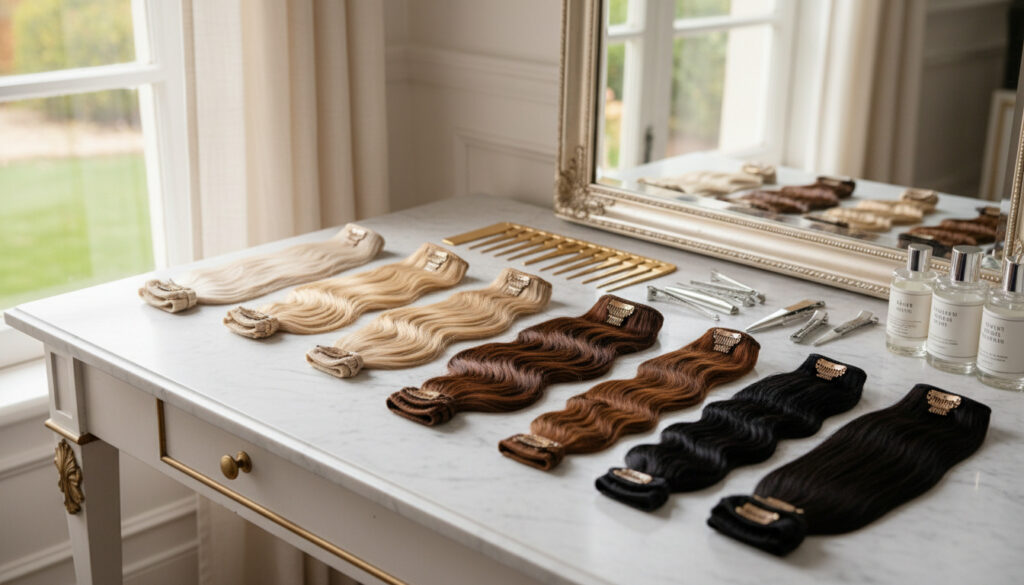
Clip-In Hair Extensions – 2025 Guide to Application and Care
Clip-in hair extensions represent the most accessible entry point into temporary hair enhancement, utilizing wefts of human or synthetic hair pre-attached with pressure-sensitive silicone grips. These temporary attachments add instant length and volume without requiring heat, adhesive, or professional salon visits, allowing users to transform their appearance within 10 to 15 minutes.
Unlike permanent extension methods that bond to natural strands for weeks or months, clip-ins offer complete flexibility for daily removal and reapplication. Proper selection of quality hair matched to natural texture and color, combined with strategic application on completely dry hair, ensures seamless integration while preventing damage to biological hair.
For those seeking versatility without commitment, this method supports styling for special events, daily enhancement, and everything between, with durability extending 6 to 12 months when maintained according to manufacturer protocols.
What Are Clip-In Hair Extensions?
These systems consist of wefted hair sections equipped with small, pressure-sensitive clips that open and close to grip natural hair securely. Unlike bonded or sewn alternatives, they require no chemical processing or heat application, making them reversible within seconds rather than hours.
| Type | Length Range | Color Options | Weft Construction |
|---|---|---|---|
| Human Hair (Remy) | 12–24 inches | Natural, balayage, ombré | Lace or polyurethane base |
| Synthetic Fiber | 10–22 inches | Fashion colors, solids | Machine-stitched wefts |
| Blended (Human/Synthetic) | 14–20 inches | Rooted, highlighted | Silicone-lined seamless |
| Specialty (Halo/Wire) | 16–24 inches | Custom dyed | Wire or invisible band |
- Installation requires zero professional training or salon equipment
- Typical lifespan ranges from 6 to 12 months depending on quality and care frequency
- Complete removal takes under 5 minutes without chemical solvents
- Silicone-lined clips prevent slippage during normal daily activities
- Suitable for fine, medium, and thick hair densities when matched correctly
- Immediate transformation without cutting or coloring natural hair
- Cost-effective alternative to semi-permanent methods requiring monthly maintenance
| Specification | Detail |
|---|---|
| Average Lifespan | 6–12 months with proper maintenance |
| Installation Time | 10–15 minutes for full head |
| Daily Wear Limit | 8 hours recommended maximum |
| Damage Risk | Zero when applied/removed correctly |
| Price Range | $50–$500 depending on hair origin |
| Clip Mechanism | Pressure-sensitive silicone grips |
| Reusability | Daily removal and reapplication permitted |
| Weight Distribution | Multiple wefts for even load bearing |
How Do You Put In Clip-In Hair Extensions?
Successful application depends on preparation, sectioning precision, and strategic placement to distribute weight evenly across the scalp. Working on completely dry hair with proper root texture ensures clips grip securely without tension.
Preparation and Sectioning
Begin with freshly washed and fully dried hair, avoiding conditioner near the roots to prevent slippage. Create horizontal partings using a rat-tail comb, starting one inch above the nape and working upward in 1 to 1.5-inch intervals.
For maximum security, lightly tease hair at root attachment zones to build anchor points, then mist with texturizing spray. Aiming to clip into thicker sections provides added support and prevents stress on individual strands.
Application Sequence
Position the largest four-clip weft approximately 1 cm below the part line for optimal security. Fasten the center clip first, then secure the sides working outward for even distribution. Continue stacking subsequent wefts upward without overlapping rows to prevent bulk.
Utilize three-clip wefts for mid-shaft volume and two-clip pieces at the sides angled toward temples. Apply the smallest single-clip wefts at the crown last, using gentle backcombing for lift if hair is fine.
Blending and Finishing
After placement, brush both natural hair and extensions together using a wide-tooth comb starting from the ends upward. Tease natural hair roots at clip positions and apply volumizing product for seamless integration. Total installation time ranges from 15 to 25 minutes when following proper technique.
Removal Protocol
Open clips fully by pressing the center release, then roll backward away from roots before gently lifting. Never pull or tug at attachment points. Store wefts flat or hung to maintain weft integrity between uses.
Do Clip-In Hair Extensions Damage Your Hair?
Evidence indicates these extensions cause zero damage to natural hair when applied and removed correctly, positioning them as the safest temporary enhancement method available. The key factors determining hair health lie in application technique and wear duration rather than the mechanism itself.
Safety Parameters
Damage occurs primarily from improper installation—specifically attaching clips to oily or damp hair, which causes slipping and requires readjustment that weakens strands. Positioning clips too close to the scalp creates tension, while too far from the root line causes visible gaps.
First-time users should allocate 15 to 25 minutes for complete application. Rushing the process increases the risk of improper sectioning and uneven weight distribution, which may lead to headaches or localized tension.
Longevity Factors
Reusable durability spans 6 to 12 months depending on construction quality, frequency of use, and environmental conditions including humidity and sun exposure. Human hair variants generally outlast synthetic alternatives, though both types require specific maintenance protocols.
Unlike permanent extensions requiring salon visits for adjustment, clip-ins allow users to remove wefts during sleep or exercise, eliminating the continuous tension that causes traction alopecia in bonded methods.
Critical Precautions
Never brush extensions while wet, as this weakens bonds and causes premature shedding. Avoid exposing wefts to chlorine or saltwater without protective barriers, and always use heat protectant before thermal styling.
Applying clips to damp or humid hair compromises the silicone grip, increasing slippage risk during wear. Always ensure hair is completely dry, and avoid heavy conditioning products at attachment zones.
What Are the Best Clip-In Hair Extensions?
Selecting optimal extensions requires matching weft construction to natural hair density and lifestyle demands. Contemporary 2025 offerings feature thinner wefts, gentler silicone-lined clips, and more dimensional blended shades than previous generations.
Hair Type Compatibility
| Natural Hair Type | Recommended Extension | Weft Construction | Clip Specification |
|---|---|---|---|
| Fine/Thin | Seamless polyurethane bands | Flat, invisible weft | Small silicone-lined clips |
| Medium Density | Lace weft or seamless | Breathable lace base | Standard silicone clips |
| Thick/Coarse | Classic lace clip-ins | Traditional machine weft | Wide grip clips |
| Sparse/Fragile | Halo wire system | Wire-based attachment | No clips required |
Quality Indicators
Prioritize Remy human hair with aligned cuticles to prevent tangling and matting. High-quality clips feature gentle silicone strips that secure without pulling, while low-grade metal alternatives may snag or lose tension after repeated use.
For color matching, utilize tester pieces before full customization. Modern dual-shade packs allow stylists to blend multiple tones for perfect matches, particularly beneficial for highlighted or balayage hair.
Investment Considerations
Entry-level synthetic sets range from $50 to $100, while premium Remy human hair extensions cost $200 to $500. The higher initial investment typically yields longer usable life and greater styling versatility, including the ability to heat-style and color-match precisely.
Clip-In vs Other Hair Extensions: Which Is Right for You?
Clip-in systems serve those seeking temporary solutions for boosting length and volume without salon dependency, contrasting sharply with tape-in methods that require professional application and semi-permanent commitment lasting 6 to 8 weeks.
Method Comparison
Tape-in extensions attach using adhesive strips requiring professional installation and specialized removal solutions. While they offer longer continuous wear time, they demand regular maintenance appointments and restrict immediate removal for activities like swimming or sleeping.
Fusion and keratin bond methods provide the most seamless appearance but involve heat application and chemical bonds that permanently alter the extension hair’s attachment point. These require significant grow-out periods and professional removal to prevent breakage.
Lifestyle Integration
For users maintaining active lifestyles or preferring to sleep without hair tension, clip-ins provide superior flexibility. Styling versatility extends to bridal arrangements, braids, updos, and voluminous ponytails, with the ability to straighten or curl using standard thermal tools when heat protectant is applied.
How Long Do Clip-In Hair Extensions Last?
The functional lifespan follows a predictable timeline based on care intensity and wearing frequency. Understanding these phases helps users maximize their investment while maintaining hair health.
- Daily Wear Cycle: Maximum 8 hours continuous attachment recommended to prevent scalp fatigue and traction stress.
- Weekly Maintenance: Full removal for cleansing natural hair and detangling extension wefts using wide-tooth implements.
- Monthly Deep Clean: Wash extensions with sulfate-free shampoo, air drying completely before storage to prevent mildew.
- Quarterly Assessment: Inspect clip tension and weft integrity; replace individual wefts showing shedding or silicone grip degradation.
- Replacement Interval: Complete set replacement every 6 to 12 months depending on quality tier and maintenance adherence.
Common Myths vs. Established Facts
Distinguishing between marketing claims and verified information helps consumers make informed decisions about temporary hair enhancement.
| Established Information | Uncertain or Variable Factors |
|---|---|
| Zero damage occurs with proper application and removal | Exact lifespan varies significantly by care frequency and climate |
| Installation requires 10–15 minutes for experienced users | Optimal daily wear duration varies by individual scalp sensitivity |
| Silicone-lined clips prevent slippage during normal activity | Specific color matching requires physical testing against natural hair |
| Human hair withstands heat styling up to 350°F with protection | Tolerance for attachment weight varies by individual hair density |
| Daily removal is necessary to prevent tension alopecia | Reaction to extension weight during high-impact exercise varies by user |
The 2025 Landscape and Ideal Candidates
Recent innovations have produced wefts thinner than previous generations, with clips engineered to distribute pressure across broader surface areas to reduce localized tension. Shade ranges now include complex balayage effects and curl patterns previously unavailable in temporary formats, accommodating diverse natural textures without chemical processing.
These systems suit individuals seeking occasional transformation for special events, those growing out awkward haircut stages, or anyone unwilling to commit to permanent chemical or adhesive methods. Zero-Emissions Vehicle – Definition Examples Benefits 2025 represents an adjacent consideration for mobile professionals traveling between styling appointments, though hair extension portability remains equipment-light compared to salon infrastructure.
Fine-haired users benefit particularly from seamless polyurethane bands that lie flat against the scalp, while those with thick hair require classic lace constructions with wide-grip clips to manage heavier weft weight.
Expert Sources and Technical Validation
High-quality clips feature gentle silicone strips that keep extensions in place without pulling, allowing easy clipping in and out with no discomfort, while low-grade clips can snag hair or lose grip.
— Hair Extension Engineering Analysis, 2025
Remy hair with aligned cuticles prevents tangling and extends usable life beyond synthetic alternatives, particularly when maintained with sulfate-free cleansing protocols.
— Trichology Research Review
Essential Takeaways for Prospective Users
Clip-in hair extensions offer a non-damaging, reversible method for instant length and volume enhancement when selected and maintained according to hair type specifications. Success depends on choosing appropriate weft construction, limiting daily wear to 8 hours, and committing to weekly removal and proper storage. For those navigating financial planning around beauty investments, Road Tax My Car – Complete UK DVLA Renewal Guide 2025 provides complementary guidance on managing recurring annual expenses.
Frequently Asked Questions
Can you sleep with clip-in hair extensions?
Sleeping with clip-ins is not recommended. Nightly removal prevents traction stress on hair follicles and extends extension lifespan by avoiding matting during sleep movement.
How much do clip-in hair extensions cost?
Quality ranges from $50 for synthetic sets to $500 for premium Remy human hair. Mid-range options ($150-$250) typically offer optimal durability for regular users.
Are clip-in hair extensions reusable?
Yes, properly maintained sets remain functional for 6 to 12 months with daily removal and weekly cleaning, making them cost-effective for repeated use.
How long do clip-in hair extensions last?
Individual wefts last 6 to 12 months depending on quality, care frequency, and environmental exposure. Synthetic variants typically require replacement sooner than human hair.
Are clip-in extensions suitable for short hair?
Extensions work best when natural hair reaches at least 6 inches to provide sufficient anchor length. Shorter hair may require strategic placement and layering to blend seamlessly.
How do you style clip-in hair extensions?
Style using flat irons or curling wands with heat protectant spray. Section hair before thermal styling to ensure even heat distribution and prevent damage to extension fibers.
More related posts
 Sophia Loren – Still Alive at 91, Age, Net Worth and Family
 Dennis Quaid – Biography, Movies, Net Worth and Family
 Darragh Ennis – Biography, Career and Personal Life
 Katie Leung – Biography Bridgerton Role and Personal Life
 Temporary Car Insurance UK – Short-Term Cover Guide
 When Was Jesus Born – Biblical Clues and Historical Facts
 Jimmy Bullard – From Premier League to Golf Presenter
 Ethel Cain – Complete Guide to Artist, Music, and 2025 Tour