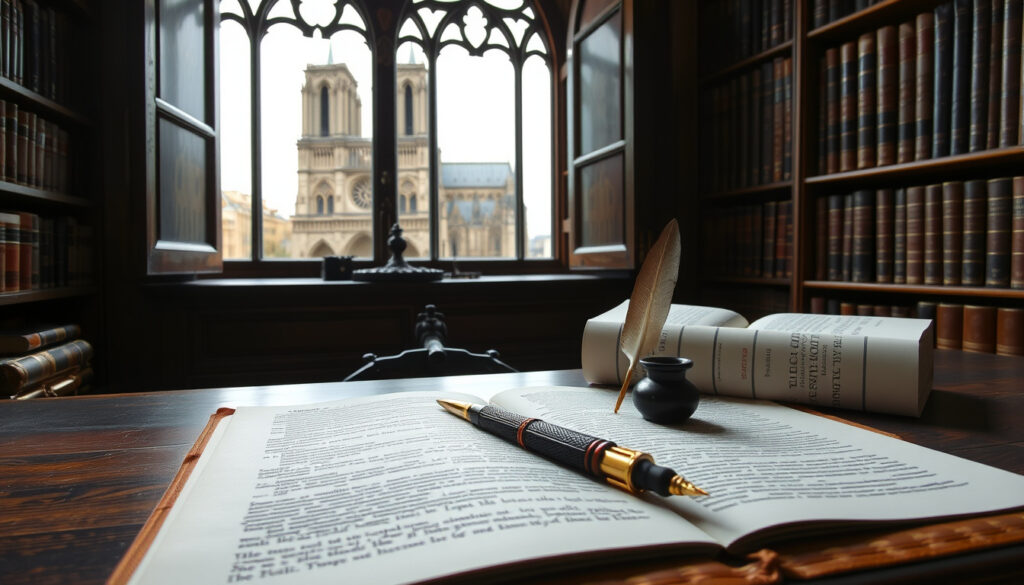
Victor Hugo – Biography, Books, and Lasting Legacy
Victor Hugo remains one of the most towering figures in French literature, a Romantic writer whose novels, poetry, and plays have shaped global culture. His name is synonymous with epic stories of justice, redemption, and the human spirit. But Hugo was also a committed political activist who spent years in exile for his beliefs.
Born in 1802 in Besançon, France, Hugo lived through a period of profound political change. He evolved from a royalist to a passionate republican, using his influence to campaign against the death penalty and for universal education. His works, especially Les Misérables and Notre-Dame de Paris, continue to resonate with readers worldwide.
Who Was Victor Hugo? A Biography of the French Romantic Writer
Quick Facts
- Victor Hugo (1802–1885) – French Romantic writer
- Famous for: Les Misérables, Notre-Dame de Paris
- Also: poet, playwright, essayist, political activist
- Died: 22 May 1885 in Paris, France
Key Insights
- Victor Hugo is one of the most influential French writers, shaping Romanticism.
- His works often grapple with social justice, redemption, and the human condition.
- Les Misérables alone has inspired countless adaptations and remains a cultural touchstone.
- Hugo’s political exile to Guernsey fueled some of his most creative periods.
- Despite his fame, many users confuse him with a modern Brazilian Jiu‑Jitsu athlete of the same name.
Snapshot Facts
| Field | Value |
|---|---|
| Full Name | Victor‑Marie Hugo |
| Born | 26 February 1802, Besançon, France |
| Died | 22 May 1885, Paris, France |
| Occupation | Writer, poet, playwright, essayist, politician |
| Notable Works | Les Misérables, Notre-Dame de Paris, The Man Who Laughs |
| Literary Movement | Romanticism |
| Known For | Human rights activism, opposition to the death penalty |
Early Life and Education (1802–1822)
Victor Hugo was born on 26 February 1802 in Besançon, France, to a military father and a royalist mother. His early education was shaped by private tutors and the rigorous study of classical literature. By his teenage years, he had already begun writing poetry and gained recognition for his talent.
Literary Beginnings and Romanticism
Hugo published his first poetry collection, Odes et Poésies Diverses, in 1822. He became a leading figure of the Romantic movement, challenging classical forms and championing individual expression. His play Hernani (1830) sparked a famous clash between Romantic and traditionalist audiences.
Political Activism and Exile
Initially a royalist, Hugo gradually shifted to liberalism and then republicanism. He served as a deputy and senator, but his opposition to Napoleon III forced him into exile in 1851. He lived first in Brussels, then Jersey, and finally settled in Guernsey in 1855, where he remained until 1870.
Final Years and Death
Hugo returned to France after the fall of Napoleon III and the proclamation of the Third Republic in 1870. He died on 22 May 1885 in Paris. His death was mourned nationally, and he received a state funeral before being buried in the Panthéon.
What Are Victor Hugo’s Most Famous Works?
Les Misérables (1862) – Plot, Themes, and Impact
Les Misérables tells the story of convict Jean Valjean seeking redemption in post‑Napoleonic France. The novel explores justice, poverty, and the human condition, and became a global phenomenon, making Hugo the most successful writer of his time.
Notre-Dame de Paris (The Hunchback of Notre‑Dame, 1831)
This novel centres on Quasimodo, the bell‑ringer of Notre‑Dame, and offers a vivid evocation of medieval life. It harshly criticises the society that shuns Quasimodo and famously spurred the first measures to save the cathedral from ruin.
Other Notable Novels: The Man Who Laughs, Toilers of the Sea
Hugo also wrote The Man Who Laughs (1869), about a disfigured boy, and Toilers of the Sea (1866), a tale of struggle against nature set in the Channel Islands. Both continue to be studied and adapted.
Victor Hugo’s Poetry and Dramatic Works
Beyond novels, Hugo produced influential poetry collections such as Les Contemplations and La Légende des siècles. His plays, including Ruy Blas and Le roi s’amuse, were later adapted into operas like Verdi’s Rigoletto.
The success of Notre-Dame de Paris led directly to the first restoration campaigns of the cathedral, which had been neglected for decades.
What Are Victor Hugo’s Most Inspiring Quotes?
Quotes from Les Misérables
Hugo’s most famous lines often come from his epic novel. One of the most beloved is: “To love another person is to see the face of God.” Another is: “Even the darkest night will end and the sun will rise.”
Quotes on Love and Humanity
Hugo wrote extensively about compassion. He said: “Laughter is the sun that drives winter from the human face.” And in a speech on poverty he called for the “end of misery and poverty.”
Quotes on Resilience and Hope
He also offered words of encouragement: “He who opens a school door, closes a prison.” These lines reflect his belief in education and progress.
Many of Hugo’s quotes are collected on Goodreads, though careful attribution to the original texts is recommended for scholarly use.
How Has Victor Hugo’s Work Been Adapted into Movies, TV, and Opera?
Film Adaptations: From Silent Era to Modern Day
Les Misérables has been filmed many times, including a 1998 version starring Liam Neeson and a 2012 musical film. The Hunchback of Notre Dame inspired Disney’s 1996 animated film and numerous other screen versions.
Notable TV Series and Miniseries
Television adaptations include the BBC’s 2018 miniseries of Les Misérables and various French productions. The stories’ themes of justice and society remain timeless.
Opera and Musical Adaptations
The most famous adaptation is the stage musical Les Misérables by Alain Boublil and Claude‑Michel Schönberg, one of the longest‑running musicals in history. Notre-Dame de Paris also became a rock opera by Richard Cocciante.
The name “Victor Hugo” also belongs to a contemporary Brazilian Jiu‑Jitsu athlete (Victor Hugo Silva). This is a different person entirely. All literary and historical references in this article pertain solely to the 19th‑century French writer.
What Were the Major Milestones in Victor Hugo’s Life?
- 1802 – Born in Besançon, France
- 1822 – Published first poetry collection, Odes et Poésies Diverses
- 1831 – Published Notre-Dame de Paris
- 1841 – Elected to the Académie Française
- 1851 – Fled to Brussels after Napoleon III’s coup; began exile
- 1855 – Settled in Guernsey
- 1862 – Published Les Misérables
- 1870 – Returned to France after fall of Napoleon III
- 1885 – Died in Paris; state funeral, buried in Panthéon
Is the Victor Hugo of BJJ the Same as the Writer?
| Established information | Information that remains unclear |
|---|---|
| Victor Hugo (1802–1885) was a French writer and political activist. | The name “Victor Hugo” also appears in modern sports, leading to confusion. |
| His life and works are thoroughly documented with no major uncertainties. | Some online queries about “Victor Hugo BJJ” or “Victor Hugo MMA” refer to a different person. |
| No controversies exist regarding his authorship or death. | The Brazilian Jiu‑Jitsu athlete Victor Hugo Silva is unrelated to the writer. |
What Was Victor Hugo’s Impact on Literature and Politics?
Victor Hugo was a central figure in the Romantic movement, championing emotional depth and individual freedom against classical constraints. Politically, he used his platform to advocate for the abolition of the death penalty, universal suffrage, and free education for all children. He spoke out against poverty, supported self‑government for Poland, and even appealed for clemency for US abolitionist John Brown.
His legacy extends beyond literature. Les Misérables continues to inspire social movements and adaptations because of its powerful themes of redemption and justice. Modern readers and viewers still find relevance in Hugo’s critique of inequality.
For context on other influential figures, you may also explore Margaret Atwood – Biography Books and Net Worth.
Where Can I Find Victor Hugo’s Most Famous Quotes?
The most cited quotes come from Les Misérables and his public speeches. Below are a few iconic examples:
“To love another person is to see the face of God.”
– Les Misérables
“Even the darkest night will end and the sun will rise.”
– Les Misérables
“Laughter is the sun that drives winter from the human face.”
– Les Misérables
“He who opens a school door, closes a prison.”
– Attributed to Hugo
What Is Victor Hugo’s Lasting Legacy?
Victor Hugo’s lasting legacy is twofold: he produced some of the most beloved literary works in history, and he used his influence to fight for human rights. His novels, poems, and plays remain widely read and adapted, while his political commitment continues to inspire activism. For a deeper dive into another world‑changing figure, see Thomas Edison – Complete Biography, Inventions, and Net Worth.
Frequently Asked Questions
Is Victor Hugo also a BJJ fighter or MMA fighter?
No, the Victor Hugo associated with Brazilian Jiu‑Jitsu (Victor Hugo Silva) is a different person. The writer Victor Hugo (1802–1885) was a French author and activist.
How many books did Victor Hugo write?
Victor Hugo wrote numerous novels, plays, poetry collections, and essays. His most famous novels are Les Misérables and Notre-Dame de Paris, but he also wrote The Man Who Laughs, Toilers of the Sea, and many others.
What is Victor Hugo’s most famous book?
Les Misérables is widely considered his most famous work, followed by Notre-Dame de Paris.
Did Victor Hugo write any operas?
Victor Hugo wrote plays that were later adapted into operas, such as Rigoletto (based on his play Le roi s’amuse) and Ernani. He did not compose operas himself.
What was Victor Hugo’s political stance?
Hugo was a committed republican and human rights activist. He opposed the death penalty, fought for social justice, and was exiled for his opposition to Napoleon III.
What is Victor Hugo’s most famous quote?
One of his most famous quotes is “To love another person is to see the face of God” from Les Misérables.
More related posts
 Sunita Mani – Biography, Career, and Personal Life
 Penny Smith – Biography, Age, Net Worth and Current Career
 Max Parker – Real Name, Age, Partner, and Emmerdale
 Gustaf Skarsgård – Biography, Height, Family and Career Facts
 Tucker Carlson – Biography, Net Worth and Latest News 2025
 Margaret Atwood – Biography Books and Net Worth
 Peter Green – Cause of Death, Biography, Songs and Legacy
 Tyger Drew-Honey – Biography, Family and Career Facts