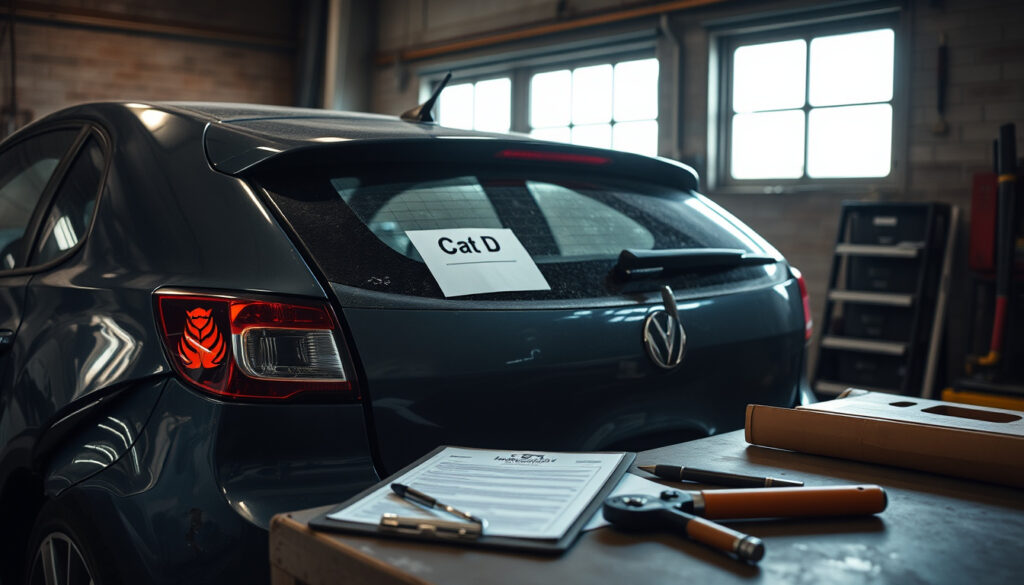
Cat D Car Meaning – Complete UK In urance Write-Off Guide
If you’ve been browsing used cars in the UK, you may have come across the term “Cat D” and wondered what it means. Cat D is one of the old insurance write‑off categories used before October 2017. It stands for Category D, and it describes a vehicle that was damaged but repairable – the insurer simply decided it wasn’t worth fixing economically. Today, its modern equivalent is Cat N (non‑structural damage), but many older vehicles still carry the Cat D label. Understanding what that label really means can help you make a smarter buying decision.
Contrary to what some assume, a Cat D designation does not mean the car is unsafe. The category was applied to vehicles with mostly cosmetic or light damage – think panels, lights, bumpers – where repair costs, plus associated fees for recovery, storage, or a hire car, exceeded the car’s pre‑accident value. The car could be repaired and legally returned to the road, and thousands of Cat D cars are driven safely every day. The key is knowing what to look for before you buy.
What Is a Cat D Car? (Definition & UK Meaning)
Cat D Car: Key Facts at a Glance
Key Insights on Cat D Cars
- Cat D cars are often safe to drive if repaired correctly, but buyers should obtain a full vehicle history check.
- Insurance premiums for a Cat D car may be higher, but many insurers still cover them.
- The Cat D category was replaced by Cat N in 2017; existing Cat D cars retain their marker.
- Resale value of a Cat D car is typically 20‑40% lower than a non‑written‑off equivalent.
- The write‑off marker is permanent – a Cat D car will always be recorded as such.
- Before buying, always request invoices, photos, and inspection records of the repair work.
Snapshot: Cat D Write‑Off Facts
| Fact | Details |
|---|---|
| Cat D stands for | Category D (insurance write‑off) |
| Damage is | Cosmetic (e.g., panels, lights, bumpers) |
| Insurer decision | Uneconomical to repair |
| Can be repaired? | Yes, and put back on the road |
| Must be recorded on | HPI register |
| Not the same as | Cat S (structural) or Cat A/B (scrap only) |
Is It Worth Buying a Cat D Car?
For budget‑conscious buyers, a Cat D car can offer significant savings. But the answer depends on your tolerance for risk and the quality of the repair work done. The following points cover the main considerations.
Repair Quality and History
The most critical factor is how well the car was repaired. A Cat D car should come with a detailed history – receipts for parts and labour, before‑and‑after photos, and, ideally, an independent inspection report. As Autotrader notes, the write‑off marker is permanent, so the car’s record cannot be erased. You must satisfy yourself that the work was done to a roadworthy standard.
Price Discount and Resale Value
A Cat D car is almost always cheaper than a clean‑title equivalent. Industry sources suggest a discount of 20‑40%, though the exact figure varies with age, mileage, and market demand. On the flip side, you should expect a similarly reduced value when you come to sell. As Motorway explains, this lower resale value is a permanent feature of any previously written‑off vehicle.
Practical Checks Before Buying
- Run an HPI check to confirm the write‑off category and any outstanding finance.
- Arrange a pre‑purchase inspection by an independent mechanic.
- Check insurance quotes before committing – not all providers cover Cat D cars.
- Request all repair documentation from the seller.
If the seller cannot provide a clear repair history or refuses an independent inspection, walk away. A well‑repaired Cat D car can be a bargain, but a poorly repaired one can be a safety risk and a financial headache.
Does Cat D Affect Insurance? (Insurance Implications)
Yes, a Cat D marker can affect both the availability and cost of insurance. While many insurers will cover a Cat D car, some will not, and those that do may charge a higher premium. According to Click Mechanic, the write‑off category reflects an insurer’s economic decision rather than the severity of the damage, but that doesn’t mean all insurers see it the same way.
Coverage and Premiums
Some mainstream insurers automatically decline any vehicle with a recorded write‑off. Others accept Cat D cars but apply a surcharge. We Buy Any Car points out that this can make insurance noticeably more expensive than for a car with a clean history. It’s always wise to shop around for quotes before you buy.
Finding an Insurer
Specialist insurers often have more flexible policies for written‑off vehicles. A broker can help you compare options. Bear in mind that the cost may also depend on the repair quality – a well‑documented professional repair could work in your favour.
Insurers are not required to refuse cover for Cat D cars, but many do. Always check with several providers and disclose the write‑off status truthfully. Failing to do so could invalidate your policy.
If you’re looking for short‑term cover, Temporary Car Insurance UK may be an option worth exploring, though availability for written‑off vehicles varies.
Cat D vs Cat N: What’s the Difference?
The simplest way to understand Cat D is to see it as the predecessor of today’s Cat N. In October 2017, the UK replaced the old Cat C and Cat D categories with Cat S (structural) and Cat N (non‑structural). Vehicles already marked Cat D kept that label, but new write‑offs now receive Cat N for non‑structural damage. Summit Garage confirms the change, noting that many buyers still confuse the old and new systems.
Comparison with Cat S and Cat C
- Cat D / Cat N – non‑structural damage; repairable and can be driven after fix.
- Cat C (old) / Cat S (new) – structural damage; also repairable, but requires stricter checks.
- Cat A – must be crushed; no parts can be reused.
- Cat B – body shell must be crushed; some parts may be salvaged.
The core distinction is structural impact. Cat N (and old Cat D) means no structural damage – the car’s frame and chassis were not affected. Cat S (and old Cat C) means the structure was damaged, which can affect crash safety and alignment. That’s why Cat S repairs generally require more scrutiny.
For more context, Carwow notes that Cat D cars “were the old category for non‑structural damage, replaced by Cat N in 2017.” If you see a car advertised as “Cat D,” think of it as a Cat N car from before the rule change.
Is Cat D Structural Damage? (Damage Type Clarification)
No. Cat D was specifically for non‑structural damage. The UK Government guidance on write‑off categories states that Cat D (and its modern equivalent Cat N) covers vehicles with damage that does not affect the structure. In contrast, Cat S (formerly Cat C) indicates structural damage such as a bent chassis or crumpled frame. A Cat D car may have dented doors, a cracked bumper, or a broken headlight – nothing that compromises the car’s structural integrity.
Timeline of Insurance Write‑Off Categories in the UK
- Pre‑2017 – Categories A, B, C, and D are used. Cat C = structural damage, Cat D = cosmetic/light damage.
- October 2017 – New categories S (structural) and N (non‑structural) are introduced to replace Cat C and Cat D.
- 2017–Present – Vehicles already marked Cat C or D keep their original label; new write‑offs receive Cat S or N.
- 2025–2026 – Cat D cars still circulate on the used market, and confusion persists among both buyers and sellers.
Certainty vs Uncertainty: What You Need to Know About Cat D Cars
Established Information
- Cat D means cosmetic damage only – not structural.
- Cat D cars can be legally driven after repair.
- Insurance companies are not required to refuse coverage for Cat D vehicles.
Information That Remains Unclear
- The quality of the repair is not guaranteed; buyers should inspect thoroughly.
- Some insurers may charge higher premiums or exclude certain covers.
- Future resale value is hard to predict accurately without a professional inspection.
Analysis: Why Cat D Cars Are Still Relevant
Despite the 2017 category overhaul, many written‑off cars on the market still carry the Cat D label. This creates a persistent source of confusion among used‑car buyers who may not fully understand the difference between old and new categories. The core distinction remains the same: Cat D (now Cat N) covers vehicles with non‑structural damage where repair costs exceed the car’s market value.
These cars can represent a genuine opportunity for value‑conscious buyers, but only if the repair was done to a high standard. The lack of a standardised repair‑quality check means a Cat D car could be perfectly safe or potentially unsafe, depending on the work carried out. A reputable HPI check and an independent inspection are essential steps before any purchase.
As the RAC puts it, “Like Cat N, a Cat D or Category D marker is assigned to a vehicle that has suffered light or cosmetic damage.” The label is not a verdict on safety – it’s an economic decision by the insurer.
Sources and Expert Quotes on Cat D Cars
“Like Cat N, a Cat D or Category D marker is assigned to a vehicle that has suffered light or cosmetic damage.”
RAC
“A Cat D vehicle is usually worth less than an identical vehicle that has never been written off.”
Autotrader
“Cat D cars were the old category for non‑structural damage, replaced by Cat N in 2017.”
Carwow
What to Do Next If You’re Considering a Cat D Car
If you’re thinking of buying a Cat D car, start with a full HPI check to confirm the write‑off category and check for outstanding finance. Then arrange an independent mechanic’s inspection. Get insurance quotes early – some providers may refuse cover, and premiums can be higher. Factor in the 20‑40% resale value reduction compared to a clean‑title car. For more guidance on insuring a written‑off vehicle, you may also find Call Admiral Car Insurance helpful.
Frequently Asked Questions
What is a Cat C car meaning?
Cat C was the previous category for structural damage (replaced by Cat S in 2017). It required a Vehicle Identity Check (VIC) before returning to the road.
What does Cat S mean on a car?
Cat S (Structural) is the post‑2017 category for cars with structural damage that can be repaired.
Can you insure a Cat D car?
Yes, most insurers will cover a Cat D car, but premiums may be higher and some providers may refuse.
How do I know if a car is Cat D?
Check the vehicle’s registration with the DVLA or use an HPI check service.
Is a Cat D car safe to drive?
If repaired correctly, a Cat D car is safe. Always verify the repair quality before buying.
Does Cat D affect the car’s value permanently?
Yes, the write‑off marker stays with the vehicle forever, reducing its resale value by 20‑40%.
What is the difference between Cat D and Cat N?
Cat D is the old label for non‑structural damage; Cat N is its modern equivalent. There is no functional difference in terms of damage type.
More related posts
 Aaron Heffernan – Biography, Career, and Personal Life
 Liz McClarnon – Biography, Husband Peter Cho and Baby News
 Elizabeth II – Complete Biography, Death, and Legacy
 Carey Mulligan – Biography, Films and Personal Life
 Nick Digiovanni – Age, Height, Net Worth and Biography 2025
 Loft Bed – Complete Buying Guide for Adults in the UK
 Where’s Hot in October – Best Destinations & Weather Guide
 France PM – Shortest Tenure in Fifth Republic History